IEEE Journal of

Selected Areas in Sensors

The IEEE Journal of Selected Areas in Sensors (JSAS), a new 100% open access technical journal, publishes papers in all areas of the field of interest of the IEEE Sensors Council, i.e., the theory, design, simulation, fabrication, manufacturing and application of devices for sensing and transducing physical, chemical, and biological phenomena, with emphasis on the electronics, physics and reliability aspects of sensors and integrated sensor-actuators. The Journal is built exclusively from papers on selected topics of current interest to the Sensors community.
Submit Manuscript

Volume Highlights

Latest Articles
Scalable and Reliable Data Framework for Sensor-Enabled Virtual Power Plant Digital Twin

Special Section on Safeguarding the Sensor-Integrated Digital Twin (SIDT): Elevating 6G Networks with Privacy and Reliability
Amritpal Singh; Umit Demirbaga; Gagangeet Singh Aujla; Anish Jindal; Hongjian Sun; Jing Jiang

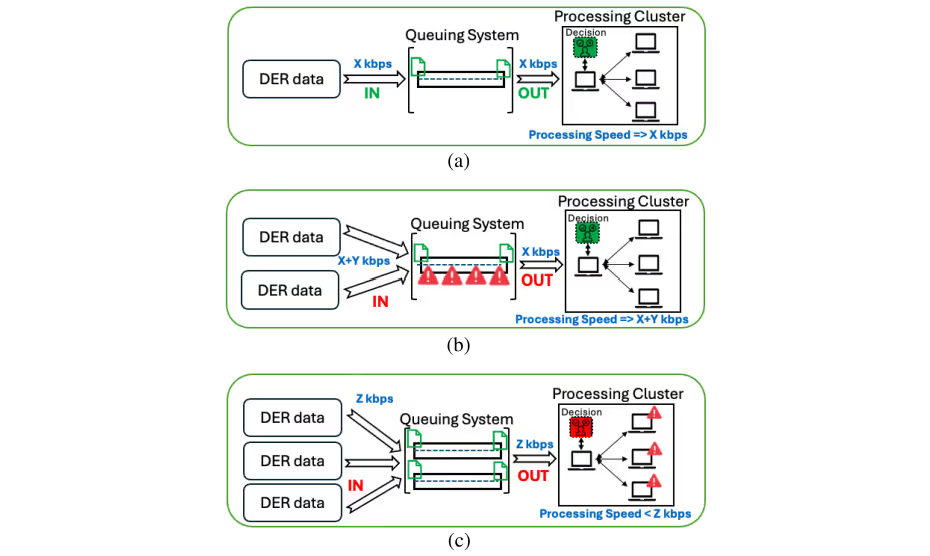
Sensor-enabled distributed energy resources (DERs) provide various advantages, including a lower carbon footprint, yet effective management of millions of DERs is still an issue. Virtual power plants (VPP) can integrate several DERs into a unified operational digital twin to enable real-time monitoring, analysis, and control. VPP may utilize advanced solutions to improve operational efficiency by combining substantial measurement data from DERs. However, effectively managing the quantity and complexity of data flows, whether streaming data or high-impact low-frequency data, is essential in maintaining the performance of DERs at sustained levels. The vast amounts of diverse data generated from various DERs pose significant challenges for storage, processing, and resource management. This article proposes a comprehensive framework that employs a distributed big data cluster to ensure scalable and reliable data storage and utilizes a robust message broker system for efficient data queuing. In addition, we present innovative load-balancing strategies within the VPP digital twin system. A decision tree algorithm is implemented to calculate the forthcoming workload collected by various deployed sensors at various DERs. The required resources are identified per workload, and the numbers are forwarded to the orchestrator. The orchestrator scales up and down resources based on resource utilization suggested by the decision tree algorithm when the resources or nodes are insufficient to handle the sensor data, optimizing the utilization of computing resources. The framework also features a failure detection component that performs root cause analysis to provide actionable insights for system optimization. Experimental results show that this framework ensures high efficiency, reliability, and real-time operational capability in VPP digital twin by addressing critical challenges in data storage, streaming data analysis, and load balancing.

Electroencephalogram and Event-Related Potential in Mild Cognitive Impairment: Recent Developments in Signal Processing, Machine Learning, and Deep Learning

Special Section on Emerging Brain Imaging, Decoding Technologies and Clinical Applications
Hamed Azami; Mina Mirjalili; Tarek K. Rajji; Chien-Te Wu; Anne Humeau-Heurtier; Tzyy-Ping Jung; Chun-Shu Wei; Thanh-Tung Trinh; Yi-Hung Liu

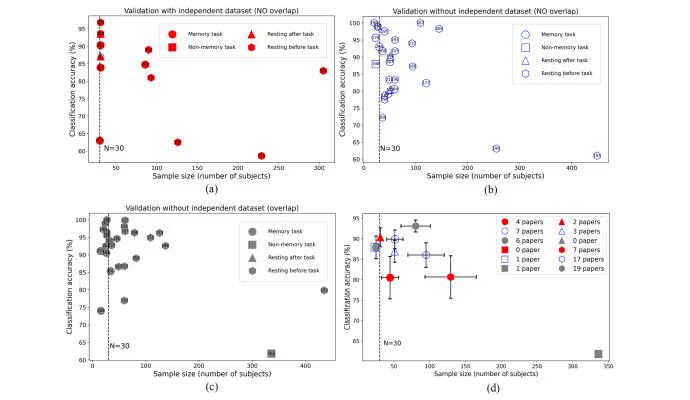
Mild cognitive impairment (MCI) is an early stage of non-age-related cognitive decline with an increased risk of progressing to dementia. Early detection of MCI is essential for implementing preventative strategies that can delay or prevent the onset of dementia, ultimately improving patient outcomes and reducing healthcare costs. Electroencephalograms (EEGs) and event-related potentials (ERPs) have shown significant promise in detecting MCI due to their affordability, real-time monitoring capabilities, and noninvasiveness. EEG provides continuous brain activity data, while ERPs offer insights into specific cognitive processes by analyzing brain responses to stimuli. These methods can complement each other in MCI diagnosis by providing a comprehensive view of overall brain function and detailed information on specific cognitive processes. However, EEG and ERP are susceptible to noise and interindividual variability, which can hinder their reliability. In addition, applying machine learning models on EEG or ERP for MCI detection presents challenges such as the risk of overfitting and difficulties in interpreting the underlying decision-making process. This review emphasizes recent advancements in signal processing and feature extraction methods applied to EEG and ERP data and explores the use of machine learning and deep learning techniques to enhance diagnostic accuracy and interpretative depth. By integrating these methodologies, the review highlights how EEG and ERP can contribute to a more effective understanding and monitoring of cognitive changes associated with MCI, underscoring the importance of early diagnosis for timely intervention and improved patient care. Finally, the review focuses on future research directions, including the development of advanced analytical techniques and multimodal integration approaches involving EEG and ERP to further improve diagnostic accuracy and clinical application.

A Survey on Digital Twins: Enabling Technologies, Use Cases, Application, Open Issues, and More

Special Section on Safeguarding the Sensor-Integrated Digital Twin (SIDT): Elevating 6G Networks with Privacy and Reliability
Vinay Chamola; Rajdipta De; Soham Das; Arjab Chakrabarti; Kuldip Singh Sangwan; Amit Pandey

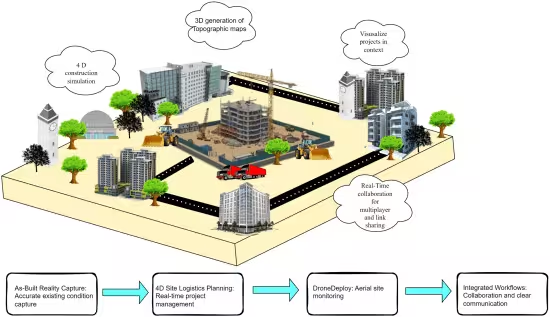
Digital Twins, sophisticated digital replicas of physical entities, have been gaining significant attention, especially after NASA's endorsement, and are poised to revolutionize numerous fields, such as medicine and construction. These advanced models offer dynamic, real-time simulations, leveraging enabling technologies, such as artificial intelligence, machine learning, IoT, cloud computing, and Big Data analytics to enhance their functionality and applicability. In the medical field, Digital Twins facilitate personalized treatment plans and predictive maintenance of medical equipment by simulating human organs with precision. In construction, they enable efficient building design and urban planning, optimizing resource use, and reducing costs through predictive maintenance. Startups are innovatively employing Digital Twins in various sectors, from smart cities—where they optimize traffic flow, energy consumption, and waste management—to industrial machinery, ensuring predictive maintenance and minimizing downtime. This survey delves into the diverse use cases, market potential, and challenges of Digital Twins, such as data security and interoperability, while emphasizing their transformative impact on industries. The future prospects are promising, with continuous advancements in AI, ML, IoT, and cloud computing driving further expansion and application of Digital Twin technologies.

MASTER: Machine Learning-Based Cold Start Latency Prediction Framework in Serverless Edge Computing Environments for Industry 4.0

Special Section on Artificial Intelligence Integrated with Smart Sensing: Techniques, Systems, and Applications
Muhammed Golec; Sukhpal Singh Gill; Huaming Wu; Talat Cemre Can; Mustafa Golec; Oktay Cetinkaya; Felix Cuadrado; Ajith Kumar Parlikad; Steve Uhlig

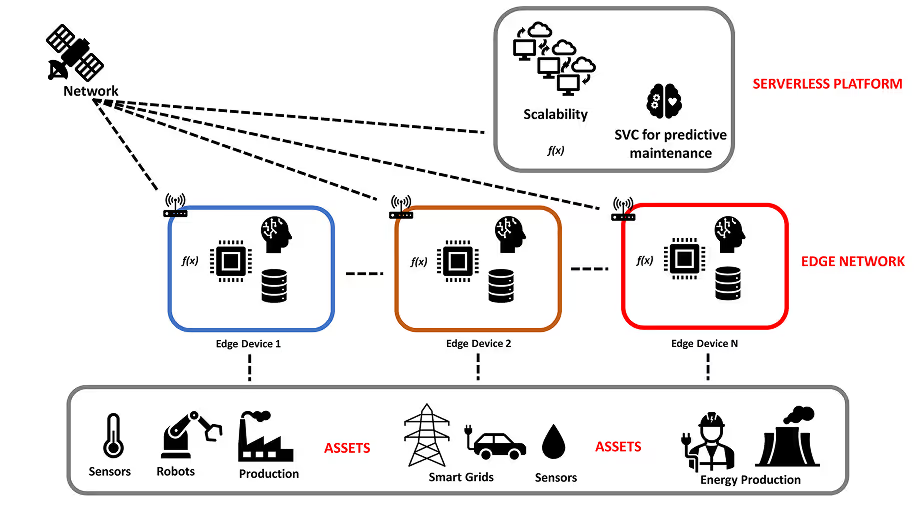
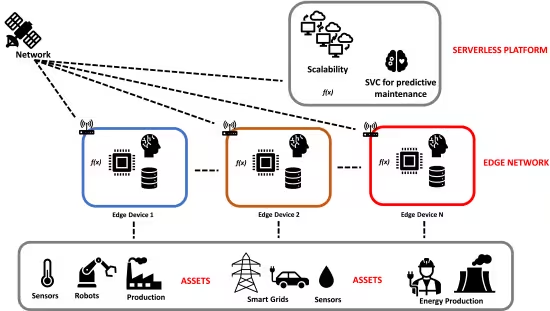
The integration of serverless edge computing and the Industrial Internet of Things (IIoT) has the potential to optimize industrial production. However, cold start latency is one of the main challenges in this area, resulting in resource waste. To address this issue, we propose a new machine learning-based resource management framework called MASTER which utilizes an extreme gradient boosting (XGBoost) model to predict the cold start latency for Industry 4.0 applications for performance optimization. Furthermore, we created a new cold start dataset using an IIoT scenario (i.e. predictive maintenance) to validate the proposed MASTER framework in serverless edge computing environments. We have evaluated the performance of the MASTER framework using a real-world serverless platform, Google Cloud Platform for single-step prediction (SSP) and multiple-step prediction (MSP) operations and compared it with existing frameworks that used deep deterministic policy gradient (DDPG) and long short-term memory (LSTM) models. The experimental results show that the XGBoost-based resource management framework is the most successful model in predicting cold start with mean absolute percentage error (MAPE) values of 0.23 in SSP and 0.12 in MSP. It has been also identified that the Linear Regression model (utilized in the MASTER framework) has the least computational time (0.03 seconds) as compared to other deep learning and machine learning models considered in this work. Finally, we compare the energy consumption and CO2 emissions of all models to emphasize resource awareness.

Editorial Board

Editor in Chief

Paul C.-P. Chao

National Yang Ming Chiao Tung University, Taiwan

Editor-in-Chief

Founding Editor-in-Chief

Chonggang Wang

InterDigital, Inc., USA

Senior Editors

Enakshi Bhattacharya

Indian Institute of Technology Madras, India

J.-C. Chiao

Southern Methodist University, USA

Jun Luo

Nanyang Technological University, Singapore

Reza Malekian

Malmö University, Sweden

Philip Pong

New Jersey Institute of Technology, USA

Sumei Sun

Institute for Infocomm Research, Singapore

Haixia (Alice) Zhang

Peking University, China

Anna Grazia Mignani

CNR – Nello Carrara Institute of Applied Physics (IFAC), Italy

Pai-Yen Chen

The University of Illinois, Chicago, USA

View More

Articile Influence Score

4.298

Citescore

21.6

Recent Issues

Browse Past Issues

Upcoming Issues

View All

Most Popular Articles

View All
Submit a manuscript now
Submit Now

Financial Sponsors

© Copyright 2023 IEEE – All rights reserved.
A not-for-profit organization, IEEE is the world’s largest technical professional organization dedicated to advancing technology for the benefit of humanity.
linkedin facebook pinterest youtube rss twitter instagram facebook-blank rss-blank linkedin-blank pinterest youtube twitter instagram